News & Media Releases
Insights to Action: Building belonging through physical activity
When over 2000 tamariki across the Western Bay of Plenty were asked how they experience school, one message stood out: not every young person felt a strong sense of belonging.
For Sport Bay of Plenty's Healthy Active Learning team, that wasn't just interesting data. It was a call to action.
“Our Voice of Tamariki survey showed that only 66 per cent of surveyed primary and intermediate students felt they belonged at school,” explains Sandy, Healthy Active Learning Advisor at Sport Bay of Plenty.
Working alongside local school leaders, the team set out to explore a simple but important question: how can physical activity help every child feel connected, included and valued?
The result was Creating a Sense of Belonging Through Physical Activity, a professional learning workshop that brought together 18 teachers from 16 kura across the Western Bay of Plenty in Term 3, 2026.
Designed in response to Voice of Tamariki insights, the workshop focussed on practical ways schools can strengthen belonging through physical activity, particularly for groups of learners who reported lower levels of belonging, including female students and learners who identified as having an impairment.
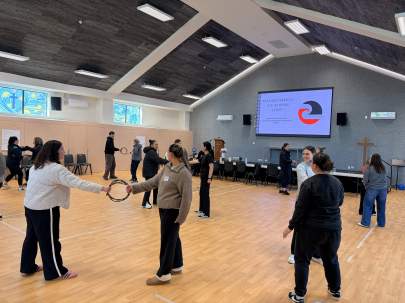
Throughout the day, educators learned from both local practitioners and specialist organisations. Jo Jackson and Sarah Williamson from Parafed Bay of Plenty led adaptive games sessions, while Tyler Wood from Halberg explored practical approaches to inclusion through physical activity. Helena Hoult from Tauranga Intermediate shared her school's work supporting female rangatahi to connect, belong and thrive, and Nick Opie from Taumata School spoke about using physical activity to strengthen connections between tamariki, staff and whānau. Sport Bay of Plenty’s Play Lead Steph Reichardt and Locally Led Advisor Devena Ruwhiu-Edmonds rounded out the programme with sessions on inclusive play spaces and inclusion through a Te Ao Māori lens.
Importantly, the workshop wasn't about adding more theory. It was about giving kaiako practical ideas they could take straight back into their schools. Through hands-on activities, discussion and examples, participants explored how physical activity can become a powerful tool for connection and belonging.
The feedback reflected that focus. Participants described the workshop as interactive, practical and thought-provoking, highlighting the value of inclusive games, adaptable activities and real-life school examples. Many said the workshop had increased their understanding of how to create opportunities for all learners to participate and succeed. Theresa Johnstone of Whakamarama School attended to learn practical ways to create a more inclusive, engaging environment where all tamariki could experience a sense of belonging.
“As a result of the workshop, we have thought carefully about what inclusivity looks like in our school and how we can develop this further with input from our community,” she said.
That focus on making physical activity more inclusive was shared by other participants. Haidee Jenkins of Greenpark School said she attended to deepen her understanding of inclusive practice and foster a stronger sense of belonging in physical activity spaces. Her goal was to bring back innovative strategies for students with physical disabilities, along with practical ideas to connect with and motivate neurodiverse tamariki who often find traditional physical activity environments challenging.
“I came away with immediate, hands-on strategies to enhance inclusion in our kura,” she said. “I’m implementing adaptive ways to play boccia to ensure every student - regardless of physical or neurodiverse challenges - can get involved and succeed. Additionally, integrating fun, traditional Māori games played with items from our natural environment will provide a refreshing, culturally rich approach to engaging all our learners.”
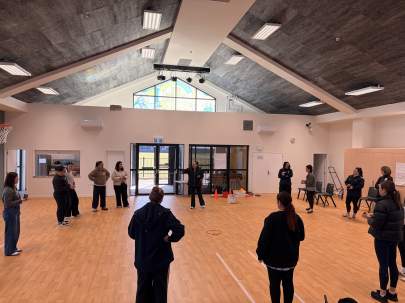
While the workshop itself has finished, the work is ongoing. Healthy Active Learning staff continue to support schools to implement ideas and share learning across their communities. A similar workshop in the Eastern Bay of Plenty was recently held in Term 4, extending the opportunity for more educators to build inclusive environments where all tamariki can participate, connect and belong.